Officine Panerai
Not logged in | Login | Create Account | Help | | Forum Search      |  

Mare Nostrum revisited

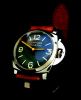
By: Asimut (registered) Saturday, January 26th, 2008 - Photo Nav: View All 1 photo(s)

Like every year before the SIHH in Geneva we ask ourselves, is this the year of the Mare? Surly, if Panerai do eventually announce the remake of the Mare Nostrum, more attention will be drawn to this model. This is one of those watches that pictures do them little justice. One just has to strap it to the wrist to appreciate its beauty and the chronograph movement is one of the more reliable I have ever witnessed.

The historic roots are of course, with the Prototype made in the early 1940's. This watch was intended to be used by deck officers but because of the way things turned around in WWII (1943), the project never materialized. Mare Nostrum (in Latin , "our sea") was the Roman name for the Mediterranean Sea . The prototype was 52mm in diameter and housed the Angelus 215 chronograph movement. This prototype was obtained by Panerai at Christie's auction in November 2005 for the sum of 132,000 SFr.

Picture of the prototype Mare Nostrum, now property of the Panerai museum:


 It is also worthwhile to mention that other timer devices made by Panerai were also branded 'Mare Nostrum', especially delay and timing devices for torpedoes and explosives.


 The first production Mare Nostrum that Panerai came up with was the 5218-301/A in 1993. It was a 42mm steel case housing a ETA 2801-2 movement with a Dubois-Depraz 3127 chrono module. This movement was the same used in all Mare Nostrums eventually made, including the ones in the Vendome era.


990 pieces were made but 100 were reworked as Slytechs and 398 were passed over to Vendome in 1997 to be reworked to PAM 6, 7 and 8 (these figures are from the book 'The Panerai of Florence by Dino Zei). This means that there are actually 492 pieces in existence.

The 5218-301/A bears a true resemblance to the original design but a 'modern' graduated bezel was added. Wearing the watch however, one feel the retrospective influence of the 1940's design. The dial is a beautiful slate blue, that has nothing to do with the original prototype dial color which was black. It so happens that the 5218-301/A was the first Panerai ever that did not house a black dial.


CLICK HERE  to read the rest of Asi's Mare Nostrum write-up